Just back from a packed two days in Northwich, meeting with some really interesting people. I've been organising a series of events for my public engagement programme, which include art workshops with school students in June, at the soon to open Lion Salt Works.
Meeting with local Artist Beth Barlow, who will be creating and facilitating the primary school workshop, I got very excited about the prospect of using glue and ink to create collaborative drawings with the students, drawings which could appear, etched in to the surface of the final commission, through their inclusion in the Barons Quay Public Art IMAGE BANK.
I visited the Barons Quay site in the centre of Northwich, and work is under way to transform this land, reclaimed by filling abandoned and dangerously unstable salt mines with a concrete composite, in to a new public and retail space.
Hearing from Danielle, who works for Fusion21, about her work to engage building and construction apprentices from the local area, I realised how much effort is being put in to ensure that the development work benefits the local community.
On Wednesday, I took the opportunity to see an exhibition of local Art at the Weaver Hall Museum in Northwich, organised by members of Visual Arts Cheshire. Whilst there, took pictures of industrial relics outside the museum:
Detail of a marine steam engine, once part of the 'Anderton', one of the last two steam powered ships built in Yarnwood's shipyard in Northwich, in 1945.
Detail of the tyre of a CAT 988s used in Winsford rock salt mine, the oldest salt mine in the country, and also the oldest working mine. The salt union extracts one million tonnes of salt from Winsford mine each year. Most of the salt is used for de-icing roads in winter.
I find industrial relics and architecture fascinating. I'm always drawn in by how the object or building's form relates to its function; looking for spouts, chutes, ladders.... to give a clue to the relic's past use.
This BLOG follows Artist Rebecca Gouldson as she designs and creates a new Public Art piece for Northwich's Barons Quay development.
Saturday, 7 March 2015
Monday, 16 February 2015
Designing, testing and planning
Experimenting with paint colours for the wall behind the artwork. The warm greys seem to work much better with the metal colours than the cool greys. The warm metal colours make the cool greys appear more lilac, and this clashes with the metal itself. A bright calico colour seems to work best (far left)
I've been working on some calculations to do with bend allowances in metal. If you're bending pieces of metal, as I will be doing in the cylinders, at the back joint, it's necessary to allow a little more metal width, to account for the bend. Working with inches and thou. and converting to mm kept me concentrating for hours......
Here, I've made three life size models of three of the metal cylinders, in cardboard. This is really useful to check proportions are right, and that the relative sizes work together visually.
I've been working on some calculations to do with bend allowances in metal. If you're bending pieces of metal, as I will be doing in the cylinders, at the back joint, it's necessary to allow a little more metal width, to account for the bend. Working with inches and thou. and converting to mm kept me concentrating for hours......
Here, I've made three life size models of three of the metal cylinders, in cardboard. This is really useful to check proportions are right, and that the relative sizes work together visually.
Saturday, 10 January 2015
Logisitics! Working out the exact sizes and placement of each cylinder....
For the past few weeks I've been working on the exact layout and sizes of the metal cylinders. This involves creating an image, to scale, plotting the ideal layout, then working out how big each cylinder is, and then, how big each part of the cylinder will be. From this, I can calculate the exact size of metal required, that will be etched and then rolled up in to a cylinder shape.
Here's a spreadsheet I'm putting together to record all the exact sizes. From these sizes, I will be able to work out how much each cylinder will weigh. I'll pass this information on to the Architects and Builders involved in the project so that they can build a bar on the interior wall for the cylinders to hang from. The weights will make sure that the bar is strong and secure enough to hold the weights of the cylinders.
Images courtesy of Dave Weaver 2014.
Here's a spreadsheet I'm putting together to record all the exact sizes. From these sizes, I will be able to work out how much each cylinder will weigh. I'll pass this information on to the Architects and Builders involved in the project so that they can build a bar on the interior wall for the cylinders to hang from. The weights will make sure that the bar is strong and secure enough to hold the weights of the cylinders.
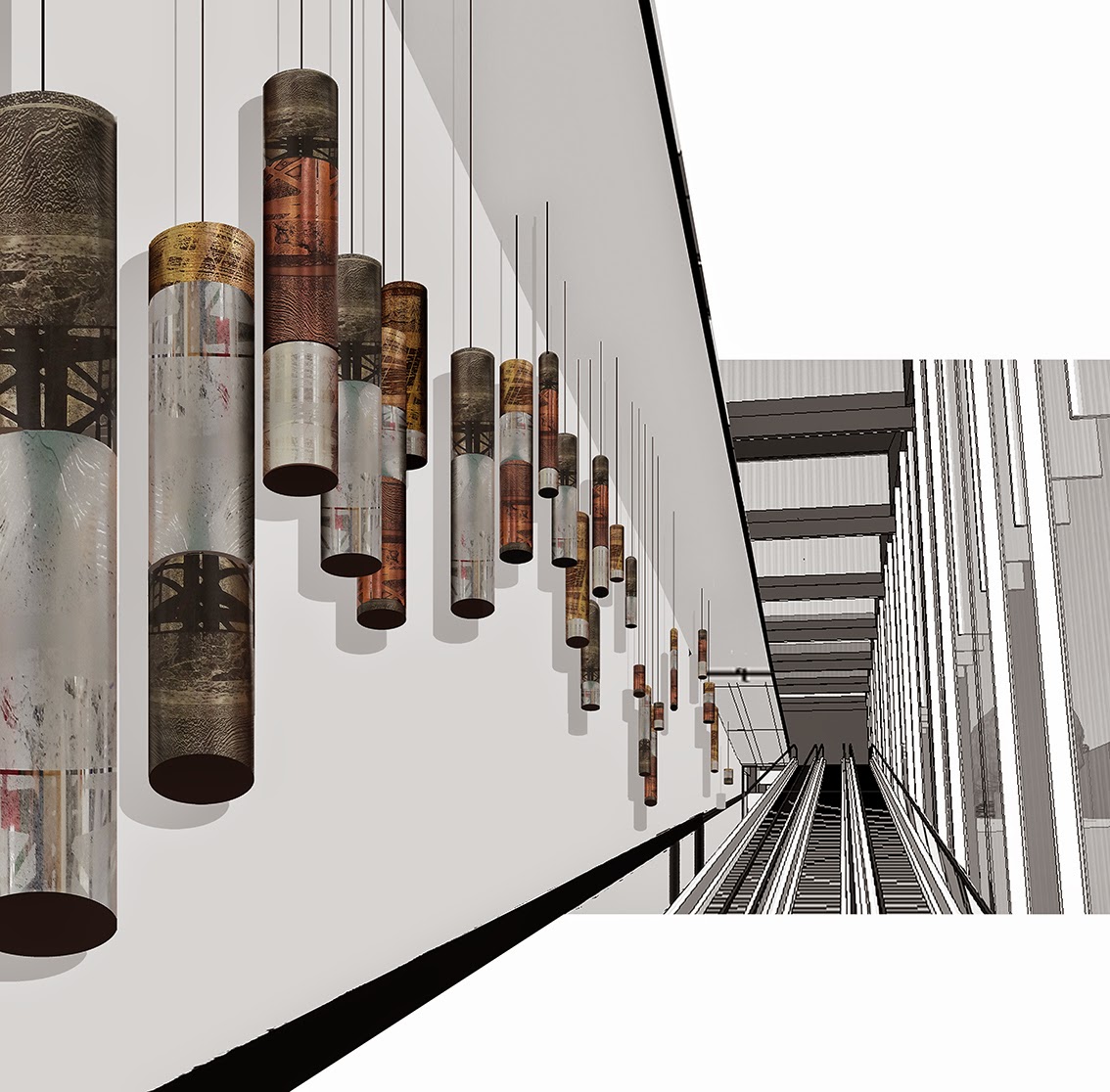
Here are some CAD (Computer Aided Design) visualisations drawn for me by Dave Weaver, who works in one of the other studios at Centrespace, where I'm based in Bristol. I've been working with Dave to come up with a structure to hold the metal cylinders together.
Images courtesy of Dave Weaver 2014.
Sunday, 21 December 2014
Visit to Lion Salt works
As part of my public art project for Barons Quay in Northwich, I'll
be working with the soon to open 'Lion Salt Works' near Northwich.
Industrial buildings have been beautifully restored and converted into
museum and cafe / shop, along with education facilities. I'm planning
to work with Lorna from the salt works, to facilitate workshops with
school students, creating artwork images for the project's IMAGE BANK.
I was really inspired to see the equipment and machinery once used in the industry, and look forward to working with Lorna to create some exciting events!
Labels:
Barons Quay,
Education,
Image Bank,
Lion Salt Works,
Public engagement,
workshops
Sunday, 30 November 2014
Bimetallic Corrosion
Today, I've been researching how different metals, when placed together, can in certain environments cause corrosion in one of the metals.
I'm doing this to make sure that the mixture of metals I've chosen for my metal cylinders, and for their substrucure, won't cause corrosion in either.
For the bimetallic corrosion to happen, there needs to be an electrolyte, like salt water. Rain will also act as an electrolyte, which is why metals used on the outside of buildings have to be selected carefully.
For my indoor cylinders, which shouldn't come in to contact with rain water, the issue of bimetallic corrosion shouldn't be as much of a threat, however I will be choosing suitable metals and using paint and lacquer to protect surfaces from eachother to prevent any problems.
Here's the chart I've created with the help of various websites, which shows each category of metal, their 'anodic index' and subsequently, the difference in anodic index between each category and another category. This difference in anodic index tells me whether I can safely use one type of metal with another.
I owe an enormous THANK YOU to Roger Francis, a leading expert in the field of metal corrosion for his assistance in selecting the right metals for the job. I'm hoping he'll be able to make it up for the launch of the commission once it's installed. http://www.rfmaterials.com/
Thanks to:
http://www.zygology.com/productcart/pc/Galvanic-Corrosion-Chart.html
http://www.estainlesssteel.com/corrosion.shtml
http://www.midastech.co.uk/pdfs/TB002-Galvaniccorrosionguide.pdf
http://www.bssa.org.uk/topics.php?article=89
http://www.galvanizeit.org/hot-dip-galvanizing/how-long-does-hdg-last/in-contact-with-other-metals
http://www.roymech.co.uk/Useful_Tables/Corrosion/Cor_bi_met.html
I'm doing this to make sure that the mixture of metals I've chosen for my metal cylinders, and for their substrucure, won't cause corrosion in either.
For the bimetallic corrosion to happen, there needs to be an electrolyte, like salt water. Rain will also act as an electrolyte, which is why metals used on the outside of buildings have to be selected carefully.
For my indoor cylinders, which shouldn't come in to contact with rain water, the issue of bimetallic corrosion shouldn't be as much of a threat, however I will be choosing suitable metals and using paint and lacquer to protect surfaces from eachother to prevent any problems.
Here's the chart I've created with the help of various websites, which shows each category of metal, their 'anodic index' and subsequently, the difference in anodic index between each category and another category. This difference in anodic index tells me whether I can safely use one type of metal with another.
I owe an enormous THANK YOU to Roger Francis, a leading expert in the field of metal corrosion for his assistance in selecting the right metals for the job. I'm hoping he'll be able to make it up for the launch of the commission once it's installed. http://www.rfmaterials.com/
Thanks to:
http://www.zygology.com/productcart/pc/Galvanic-Corrosion-Chart.html
http://www.estainlesssteel.com/corrosion.shtml
http://www.midastech.co.uk/pdfs/TB002-Galvaniccorrosionguide.pdf
http://www.bssa.org.uk/topics.php?article=89
http://www.galvanizeit.org/hot-dip-galvanizing/how-long-does-hdg-last/in-contact-with-other-metals
http://www.roymech.co.uk/Useful_Tables/Corrosion/Cor_bi_met.html
Saturday, 29 November 2014
In the press!
Yesterday, I appeared in the Northwich Guardian, talking about my new
Public Art project at the soon to be build Barons Quay development,
which will sit on top of a disused and recently filled, historic salt
mine.
Here's
a link to the online version of the article:
http://www.northwichguardian.co.uk/news/11621349.Barons_Quay_art_plans_revealed/
Photo courtesy of Nick Jones at the Northwich Guardian
Labels:
Award,
Barons Quay,
Northwich,
Northwich Guardian,
Public Art
Awarded large scale Public Art project at Barons Quay in Northwich
I'm
delighted to announce that I've been selected by Chester and Cheshire
West Council to create a public art piece for a 200 metre square space
at the soon to be built, Barons Quay development in Northwich.For the space, I'll be creating 50, up to a metre long etched metal cylinders, which will be suspended from the ceiling, and undulate across the wall in the profile of the local river Weaver.
The form of the piece is rooted in the site's industrial heritage, referencing rock salt mines which still exist, but have been recently filled, underneath the new development's site. The cylinders are evocative of 'core samples' pulled from the earth, revealing layers of rock which tell the geological story of a landscape.
I will be working with the local community to develop salt inspired artwork which will influence some of the imagery etched in to these metal cylinders, engaging them in the creative process of producing a public artwork.
The piece will be installed in 2017 after the development of Barons Quay is complete.
Subscribe to:
Posts (Atom)