Showing posts with label Metal. Show all posts

Friday, 10 June 2016

Installation!

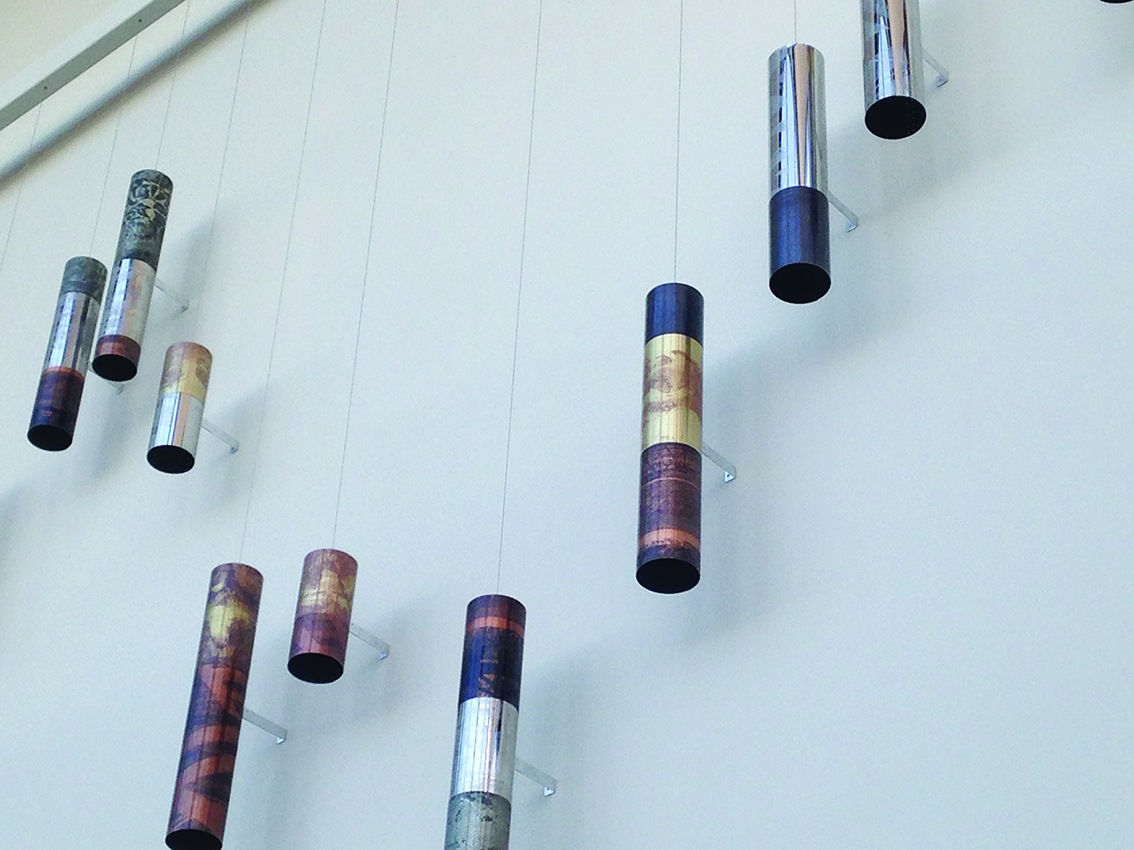
I'm excited to report that the cylinders have now been installed at Barons Quay! It was fantasitc to see them hanging finally and I felt very proud of myself, and all the people who have contributed to the project, especially the students at Hartford High and Leftwich Primary School whose artwork is etched in to the surface of the cylinders. A big congratulations to you all!


A huge thanks to the lads at Art fabrications http://www.artfabs.co.uk/ for doing such a fantastic job!

Sunday, 6 September 2015

Creating designs for the cylinders' surface pattern.

 Here's a sneak peek at my final design proposal for the surface etchings on the metal cylinders using artwork created by myself, and students from two local schools; Leftwich Primary school, and Hartford High school.   More images of the fantastic work produced by students can be found on the image bank here...  https://www.flickr.com/photos/129716078@N08/albums


Sunday, 23 August 2015

Designing the etched metal cylinder surfaces

For the past couple of months, I've been using the artwork produced in the school workshops, combined with some mono-prints and salt related imagery of my own, to produce the artwork that will eventually be etched on to the surface of the metal cylinders.

Much of the design work is done on the computer, by manipulating, resizing and layering images which will produce different qualities of texture when etched in to the different metals; copper, brass, white brass and stainless steel.


Saturday, 11 July 2015

Making progress...

I've been working hard on creating prototypes of the metal cylinders which will be eventually hung in Barons Quay.  I've been working on how the cylinders achieve the layered compositon, with copper, brass and white brass etchings layered on top of one another.

The challenge is to keep the cylinders as light as possible, whilst being structurally sound and maintaining the high level of craftsmanship I always strive for.
 Contrasting metallic colours.
 I was excited to try etching textural salt deposit - like images on to the stainless steel cylinder.  It's really beautiful the way the shiny metal contrasts the etched matt grey image.

Monday, 16 February 2015

Designing, testing and planning

 Experimenting with paint colours for the wall behind the artwork.  The warm greys seem to work much better with the metal colours than the cool greys.  The warm metal colours make the cool greys appear more lilac, and this clashes with the metal itself.  A bright calico colour seems to work best (far left)
 I've been working on some calculations to do with bend allowances in metal.  If you're bending pieces of metal, as I will be doing in the cylinders, at the back joint, it's necessary to allow a little more metal width, to account for the bend.  Working with inches and thou. and converting to mm kept me concentrating for hours......
Here, I've made three life size models of three of the metal cylinders, in cardboard.  This is really useful to check proportions are right, and that the relative sizes work together visually.

Sunday, 30 November 2014

Bimetallic Corrosion

Today, I've been researching how different metals, when placed together, can in certain environments cause corrosion in one of the metals.

I'm doing this to make sure that the mixture of metals I've chosen for my metal cylinders, and for their substrucure, won't cause corrosion in either. 

For the bimetallic corrosion to happen, there needs to be an electrolyte, like salt water. Rain will also act as an electrolyte, which is why metals used on the outside of buildings have to be selected carefully.

For my indoor cylinders, which shouldn't come in to contact with rain water, the issue of bimetallic corrosion shouldn't be as much of a threat, however I will be choosing suitable metals and using paint and lacquer to protect surfaces from eachother to prevent any problems.

Here's the chart I've created with the help of various websites, which shows each category of metal, their 'anodic index' and subsequently, the difference in anodic index between each category and another category. This difference in anodic index tells me whether I can safely use one type of metal with another.

I owe an enormous THANK YOU to Roger Francis, a leading expert in the field of metal corrosion for his assistance in selecting the right metals for the job.  I'm hoping he'll be able to make it up for the launch of the commission once it's installed.    http://www.rfmaterials.com/


Thanks to:

http://www.zygology.com/productcart/pc/Galvanic-Corrosion-Chart.html
http://www.estainlesssteel.com/corrosion.shtml
http://www.midastech.co.uk/pdfs/TB002-Galvaniccorrosionguide.pdf
http://www.bssa.org.uk/topics.php?article=89
http://www.galvanizeit.org/hot-dip-galvanizing/how-long-does-hdg-last/in-contact-with-other-metals
http://www.roymech.co.uk/Useful_Tables/Corrosion/Cor_bi_met.html